Investment in visual communication: how to aim accurately?
Investment in visual communication: how to aim accurately?
Investment in visual communication: how to aim accurately?

In a saturated market of visual and competitive information, investing in visual communication becomes essential for any company wishing to stand out effectively. But how can you be sure you are investing well? It is vital to precisely structure your strategy, from choosing objectives to evaluating results, including budget allocation and selecting the appropriate media.
Structuring your visual communication strategy
Clearly defining your marketing objectives
The clarity of objectives determines the effectiveness of the strategy. Do you want to increase your brand awareness, generate leads, build loyalty among customers, or launch a new product? Each objective requires distinct choices of media and formats.
For example, short videos are ideal for a product launch on social media, while educational infographics are better suited for informative objectives.
Capturing attention with a powerful visual message
To capture attention in a few seconds, focus on simple, clean visuals with high aesthetic value. A clear visual message allows for immediate understanding and lasting recall, two key elements in an effective communication strategy.

The example of the photos taken for XFeet perfectly illustrates this principle: a sober design, perfectly mastered lighting, precise framing, and a deliberate focus on the material. The result? High-end visuals that reinforce the perceived quality image of the product and immediately inspire confidence. A good photo can thus, on its own, raise the positioning of a brand in its market.
Strengthening recognition through a consistent visual identity
Graphic consistency is a major key to ensuring your brand is recognized quickly and remembered long-term. The logo, color palette, typography, and photographic style must remain uniform across all media, whether digital or print. This consistency considerably strengthens your credibility and professional image.
Concrete example: Carole Teyssier Organisation
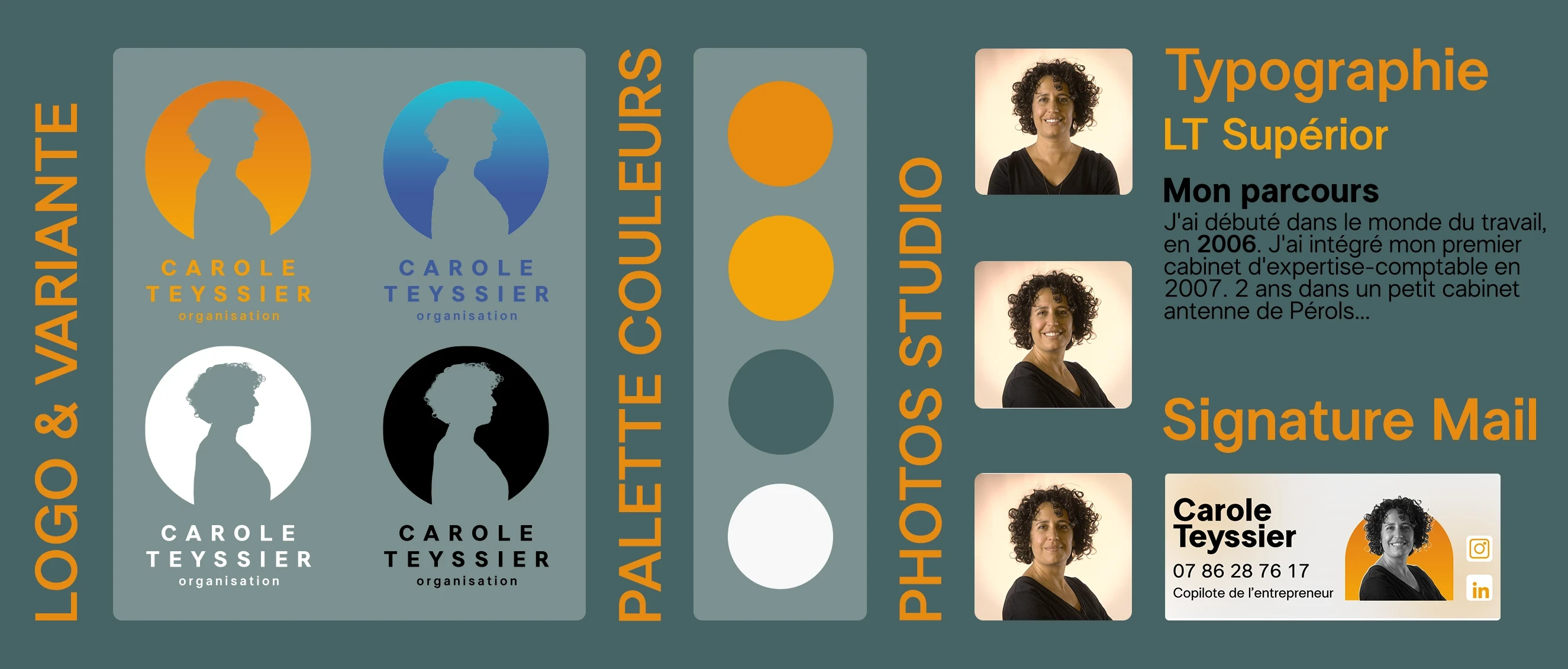
We designed a custom brand identity in her image: warm, professional, and structured. Before this, she had no artistic direction. Since implementing this new AD, Carole notes a clear improvement in the perception of her partners:
« Professional presentations, taken seriously by partners. »
Standing out through visual innovation
In a highly competitive market, standing out requires innovating in your visual media. Adopting an original approach allows your company to assert its positioning. Integrating emerging formats (augmented reality, graphic animations...) strengthens engagement and attracts new clients.
Allocating a budget suited to your ambitions
An effective investment in visual communication varies according to the industry, the size of the company, and its objectives. Here are indicative ranges of marketing budget (including visual communication) according to different sectors:
Industry sector | % of revenue allocated to marketing |
|---|---|
B2B Company | 2 - 5 % (HubSpot, 2025) |
B2C Company | 5 - 10 % (HubSpot, 2025) |
Consumer Packaged Goods (CPG) | ~18 % (HubSpot, 2025) |
Food & Beverage | 3 - 6 % (Restaurant Growth, Jul. 2024) |
Construction | ~10.2 % (HubSpot - Mining/Construction sector) |
Fashion / Luxury / Cosmetics | 5 - 10 %, up to 25 % with PR, events, sponsorship (Marketing Week, 2023) |
Initial investment: redesign & launch
The communication budget can be higher at the launch of an activity or during a complete redesign (new website, new graphic identity, creation of visuals, digital strategy, etc.). This initial cost can be quickly amortized if used intelligently as a strategic lever, creating assets that continue to perform over time.
Choosing the right and suitable tools
To obtain professional visuals, use recognized industry-standard tools. Here are the ones we use at Shogun Pictures:
Adobe Photoshop / Illustrator: graphic design
Figma / Framer / WordPress / Shopify: web design & websites
Blender / Houdini: 3D and VFX
Nuke / DaVinci Resolve: post-production & color grading
These tools involve significant annual costs (licenses, training, equipment) but guarantee a high-end result.
At SPC, it is also our original ideas, our team cohesion, and our visual culture that make the difference.
Measuring effectiveness to optimize visual return on investment
Measuring effectiveness allows you to quickly adjust your visual communication strategy and optimize your future investments. Here are the main KPIs to track:
Engagement rate: clicks, shares, comments
Web traffic: visits coming from your visuals
Conversions: leads, sales, sign-ups
Brand awareness: qualitative surveys
ROI: ratio of spending to benefits obtained
A regular follow-up guarantees a more profitable and precise strategy.
Concrete cases: results in figures
ProFondation (construction sector)
In 2024, we supported ProFondation in a comprehensive redesign of its brand image: graphic identity, website, brochures, t-shirts, banners, etc.
Results between June 2024 and June 2025 on the ProFondation website:
+500 % forms received
→ Contacts sent via the website+977 % unique visitors
→ Distinct internet users over the period+643 % sessions (unique user returning)
→ Total visits, from all sources combined+1567 % organic Google traffic
→ Visits from SEO results
Concrete proof that consistent and well-thought-out visual communication can double, triple... or even multiply by 10 the impact of a company, even in a technical sector like construction.
Conclusion: Investing effectively to grow sustainably
Investing in visual communication is a strategic lever for any modern business. A rigorous approach, combining clear objectives, choice of tools, and continuous analysis of results, allows turning every euro invested into a significant competitive advantage.
A good visual strategy leaves a memorable imprint, generates loyalty, and becomes a competitive advantage in the long run.
In a saturated market of visual and competitive information, investing in visual communication becomes essential for any company wishing to stand out effectively. But how can you be sure you are investing well? It is vital to precisely structure your strategy, from choosing objectives to evaluating results, including budget allocation and selecting the appropriate media.
Structuring your visual communication strategy
Clearly defining your marketing objectives
The clarity of objectives determines the effectiveness of the strategy. Do you want to increase your brand awareness, generate leads, build loyalty among customers, or launch a new product? Each objective requires distinct choices of media and formats.
For example, short videos are ideal for a product launch on social media, while educational infographics are better suited for informative objectives.
Capturing attention with a powerful visual message
To capture attention in a few seconds, focus on simple, clean visuals with high aesthetic value. A clear visual message allows for immediate understanding and lasting recall, two key elements in an effective communication strategy.
The example of the photos taken for XFeet perfectly illustrates this principle: a sober design, perfectly mastered lighting, precise framing, and a deliberate focus on the material. The result? High-end visuals that reinforce the perceived quality image of the product and immediately inspire confidence. A good photo can thus, on its own, raise the positioning of a brand in its market.
Strengthening recognition through a consistent visual identity
Graphic consistency is a major key to ensuring your brand is recognized quickly and remembered long-term. The logo, color palette, typography, and photographic style must remain uniform across all media, whether digital or print. This consistency considerably strengthens your credibility and professional image.
Concrete example: Carole Teyssier Organisation
We designed a custom brand identity in her image: warm, professional, and structured. Before this, she had no artistic direction. Since implementing this new AD, Carole notes a clear improvement in the perception of her partners:
« Professional presentations, taken seriously by partners. »
Standing out through visual innovation
In a highly competitive market, standing out requires innovating in your visual media. Adopting an original approach allows your company to assert its positioning. Integrating emerging formats (augmented reality, graphic animations...) strengthens engagement and attracts new clients.
Allocating a budget suited to your ambitions
An effective investment in visual communication varies according to the industry, the size of the company, and its objectives. Here are indicative ranges of marketing budget (including visual communication) according to different sectors:
Industry sector | % of revenue allocated to marketing |
|---|---|
B2B Company | 2 - 5 % (HubSpot, 2025) |
B2C Company | 5 - 10 % (HubSpot, 2025) |
Consumer Packaged Goods (CPG) | ~18 % (HubSpot, 2025) |
Food & Beverage | 3 - 6 % (Restaurant Growth, Jul. 2024) |
Construction | ~10.2 % (HubSpot - Mining/Construction sector) |
Fashion / Luxury / Cosmetics | 5 - 10 %, up to 25 % with PR, events, sponsorship (Marketing Week, 2023) |
Initial investment: redesign & launch
The communication budget can be higher at the launch of an activity or during a complete redesign (new website, new graphic identity, creation of visuals, digital strategy, etc.). This initial cost can be quickly amortized if used intelligently as a strategic lever, creating assets that continue to perform over time.
Choosing the right and suitable tools
To obtain professional visuals, use recognized industry-standard tools. Here are the ones we use at Shogun Pictures:
Adobe Photoshop / Illustrator: graphic design
Figma / Framer / WordPress / Shopify: web design & websites
Blender / Houdini: 3D and VFX
Nuke / DaVinci Resolve: post-production & color grading
These tools involve significant annual costs (licenses, training, equipment) but guarantee a high-end result.
At SPC, it is also our original ideas, our team cohesion, and our visual culture that make the difference.
Measuring effectiveness to optimize visual return on investment
Measuring effectiveness allows you to quickly adjust your visual communication strategy and optimize your future investments. Here are the main KPIs to track:
Engagement rate: clicks, shares, comments
Web traffic: visits coming from your visuals
Conversions: leads, sales, sign-ups
Brand awareness: qualitative surveys
ROI: ratio of spending to benefits obtained
A regular follow-up guarantees a more profitable and precise strategy.
Concrete cases: results in figures
ProFondation (construction sector)
In 2024, we supported ProFondation in a comprehensive redesign of its brand image: graphic identity, website, brochures, t-shirts, banners, etc.
Results between June 2024 and June 2025 on the ProFondation website:
+500 % forms received
→ Contacts sent via the website+977 % unique visitors
→ Distinct internet users over the period+643 % sessions (unique user returning)
→ Total visits, from all sources combined+1567 % organic Google traffic
→ Visits from SEO results
Concrete proof that consistent and well-thought-out visual communication can double, triple... or even multiply by 10 the impact of a company, even in a technical sector like construction.
Conclusion: Investing effectively to grow sustainably
Investing in visual communication is a strategic lever for any modern business. A rigorous approach, combining clear objectives, choice of tools, and continuous analysis of results, allows turning every euro invested into a significant competitive advantage.
A good visual strategy leaves a memorable imprint, generates loyalty, and becomes a competitive advantage in the long run.